
Why Your Water’s pH Matters More Than You Think
When most people think about the quality of their drinking water, they think about clarity and taste. Does it look clean? Does it taste funny?
These are reasonable starting points. But they miss one of the most important and least visible characteristics of your water: its pH.
pH is a measure of how acidic or alkaline a substance is. And while it might sound like a chemistry class concept with no practical application, the pH of your drinking water can directly affect your health, your hydration efficiency, the safety of your pipes, and even the taste of everything you cook.
Here is why it matters more than most people realise.
Understanding the pH Scale
The pH scale runs from 0 to 14. A pH of 7 is perfectly neutral. Anything below 7 is acidic, battery acid sits at 0, lemon juice at around 2, coffee at about 5. Anything above 7 is alkaline seawater is around 8, baking soda at 9.
Pure water sits at 7. However, almost no water source in the real world has a perfectly neutral pH. Tap water in Nigeria typically has a pH between 6 and 7.5 depending on the source, treatment process, and pipe condition. Borehole water can range more widely. Sachet water pH is largely unregulated and varies by brand.
The WHO recommends drinking water have a pH between 6.5 and 8.5. Slightly alkaline water in the 7.5 to 8.5 range is widely considered optimal for health.
Acidic Water Can Carry Dangerous Contaminants
This is perhaps the most practical concern for Nigerian households. Acidic water is chemically reactive. When slightly acidic water flows through metal pipes particularly older iron or lead pipes common in Nigerian infrastructure it dissolves small amounts of metal as it travels.
This means that water which was tested safe at the source can arrive at your tap carrying lead, copper, and iron that it picked up from corroded pipes along the way. The more acidic the water, the more aggressively it leaches metal from pipes. A properly alkaline water supply dramatically reduces this risk.
pH Affects Mineral Absorption
Water with a balanced or slightly alkaline pH typically contains dissolved alkaline minerals like calcium, magnesium, and bicarbonate. These minerals are beneficial for bone health, muscle function, and heart health. They are also bioavailable meaning the body can absorb and use them efficiently.
Acidic water, by contrast, tends to lack these minerals and in some cases can interfere with the body’s own mineral balance by contributing to an acid load that the body must neutralise, often by drawing calcium from bones.
pH Directly Affects the Taste of Your Water
Have you ever noticed that some water from certain sources has a metallic, sour, or slightly bitter taste? That is almost always a pH problem. Acidic water tastes metallic or sour because it contains dissolved metals and lacks buffering minerals. Extremely alkaline water can taste slightly bitter or soapy. Properly balanced water at pH 7.5 to 8.5 tastes clean, smooth, and refreshing.
This is not a subjective preference. When water tastes better, people drink more of it. And drinking more water is one of the simplest, most impactful things any person can do for their health.
pH Influences Your Body’s Internal Environment
The human body maintains a blood pH of approximately 7.35 to 7.45. This range is tightly regulated and essential for survival. While drinking water alone cannot significantly alter blood pH (the body has robust buffering systems to prevent this), the overall acid load of your diet and water does create work for those systems.
A modern Nigerian diet high in processed foods, fried food, soft drinks, and red meat is predominantly acid-forming. Consistently drinking water with a slightly alkaline pH contributes to reducing this load, supporting the body’s natural buffering systems rather than adding to their burden.
Proper pH Supports Better Hydration
Alkaline water containing electrolytes has been shown in some studies to support more efficient cellular hydration than neutral or acidic water. The presence of minerals helps water cross cell membranes more effectively, meaning your cells actually take in more of the fluid you drink. In a hot climate like Nigeria’s, this difference in hydration efficiency is not trivial.
“The pH of your water is not just a number. It is a reflection of the mineral content, the safety of your pipes, and the quality of hydration your body receives with every glass.”
Where Does the Specullum Puriffier Sit?
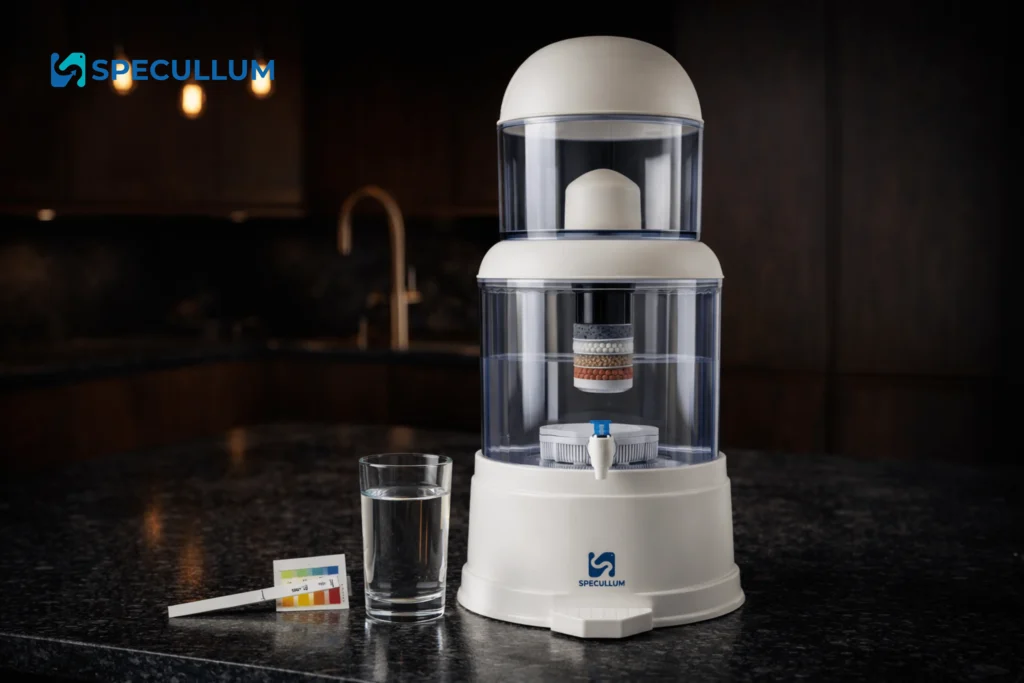
The Specullum Gravity Water Purifier produces water in the optimal 8.0 to 8.5 pH range. Its silica sand stage reduces acidity in filtered water, and its alkaline filter stage raises pH to the ideal drinking range by allowing the water to absorb bicarbonate and alkaline minerals from its filter media.
The result is water that is balanced, mineralised, and positioned in exactly the pH zone where taste, hydration efficiency, and health benefit overlap. Not too acidic. Not excessively alkaline. Just right.